
Product deep dive
OptiReaders Pro glasses: lens, frame, specs and who they suit
A plain-English breakdown of the progressive multifocal lens, the four coatings, the 22-gram TR90 frame, the full specification table and the people these readers are - and are not - designed for.
Official store pricing
1 Pair $29.99 · 2 Pairs $49.99 · 3 Pairs $69.99
Free shipping on 2+ pairs · 30-day money-back guarantee
The lens: one surface, three powers
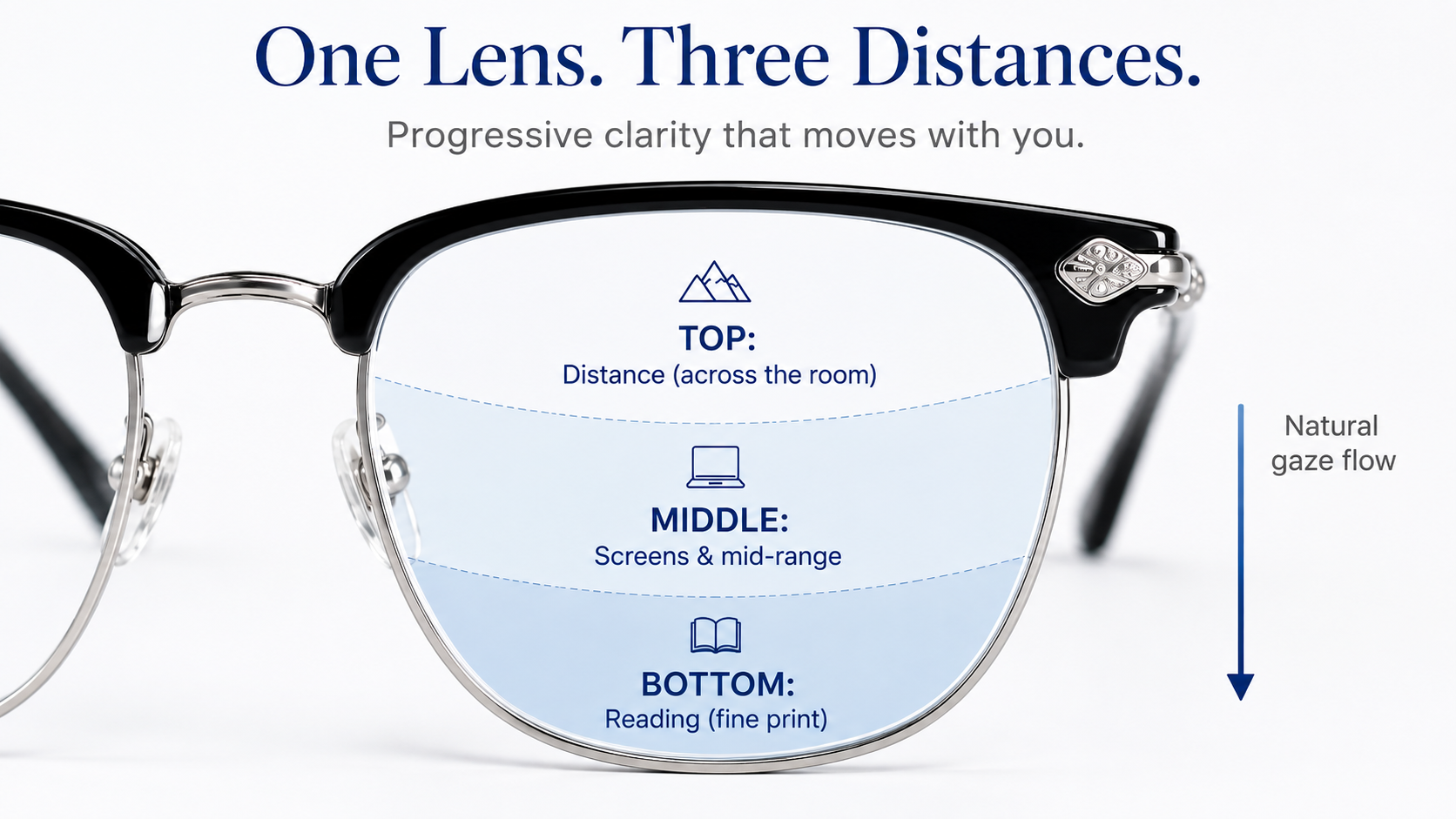
A progressive multifocal lens changes power gradually from top to bottom. The upper band is left close to neutral so the room stays natural. The middle band adds a moderate boost that lands exactly where a laptop or a dashboard sits. The lower band carries the full magnification for print, phones and medicine labels.
Because the change is gradual there is no visible line and no jump between zones. Your eye finds the right band the same way it already tilts to read - you simply learn to point your nose at whatever you are looking at.
Full specifications
| Lens type | Progressive multifocal, three zones, no visible line |
|---|---|
| Powers available | +1.00 to +3.50 in +0.25 steps (11 options) |
| Coatings | Blue-light filter, anti-reflective, scratch-resistant hard coat, oleophobic |
| Frame material | TR90 memory polymer with metal temple detailing |
| Weight | Approx. 22 g |
| Fit | Unisex, softened rectangle, moulded nose pads |
| Prescription needed | No - non-prescription readers for presbyopia |
| In the box | Glasses, hardshell case, microfiber cloth |
| Returns | 30 days from delivery, refund of product price |
| Shipping | Packed within 24h on business days, tracked worldwide |
Coatings that matter day to day
- Blue-light filtering: trims the harshest short-wavelength part of screen light for long laptop sessions.
- Anti-reflective: kills the ghost reflections from overhead office lighting and oncoming headlights.
- Scratch-resistant hard coat: survives being dropped in a bag without a case.
- Oleophobic top layer: fingerprints wipe off with the included cloth instead of smearing.
The frame: 22 grams of TR90
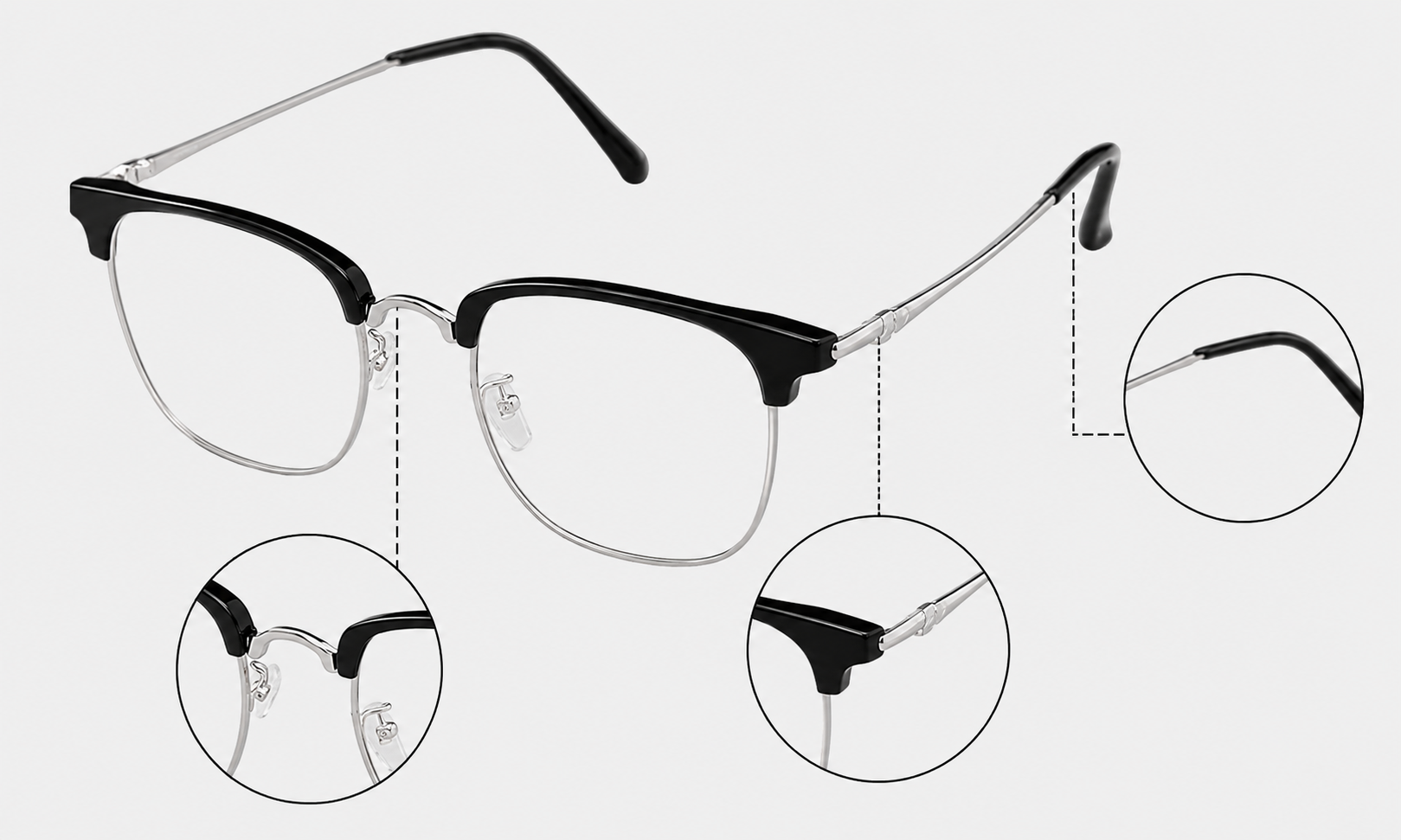
The frame is TR90 memory polymer with slim metal detailing at the temples, weighing roughly 22 grams. TR90 bends rather than snaps, which is why these survive being sat on far better than a rigid acetate reader.
The shape is deliberately neutral - a slightly softened rectangle in a unisex width that suits most adult faces. Nose pads are moulded rather than wire-mounted, so there is nothing to bend out of alignment.
How to choose your strength
Presbyopia tracks age closely, which is why a non-prescription reader can work so well for close-up blur. If you already own drugstore readers, order the same number you wear today. If you are starting from scratch, use the band below and adjust later - we swap the power free inside 30 days.
| Your age | Suggested power | What it fixes |
|---|---|---|
| 40 - 44 | +1.00 | Small print drifts at the end of the day |
| 45 - 49 | +1.50 | Menus and labels need a little more arm |
| 50 - 54 | +2.00 | The most ordered strength |
| 55 - 59 | +2.50 | Phone text comfortable at normal distance again |
| 60+ | +3.00 to +3.50 | Fine print, sewing, medicine labels |
The full breakdown, including what to do if you are between two powers, is in the OptiReaders Pro strength guide.
Progressive vs. single-power vs. computer readers
| OptiReaders Pro | Drugstore readers | Computer glasses | |
|---|---|---|---|
| Distances covered | Three (near, screen, room) | One | One (screen) |
| Look up without removing | Yes | No | Partly |
| Blue-light filter | Yes | Rarely | Usually |
| Typical weight | 22 g | 25 - 35 g | 25 - 30 g |
| Price per pair | $25.00 on the 2-pair bundle | $15 - $25 | $30 - $80 |
Getting used to them
Give them two or three short sessions. Wear them at a desk first, where all three distances get used naturally. Move your head rather than your eyes when scanning across a wide screen. Almost everyone is comfortable inside a day; a small minority never gel with progressive lenses at all, which is exactly what the 30-day return window is for.
Common problems and how to fix them
- Edges look soft. Normal for any progressive lens. Turn your head instead of sliding your eyes sideways and it disappears within a day or two.
- Stairs feel odd. You are reading the floor through the magnified lower band. Take them off on stairs during the first week.
- Print is still blurry. The power is likely one step too low. Email us and we swap it free within 30 days.
- Screen sits in the wrong zone. Raise the monitor or lower the chair so the screen is slightly below eye level - that puts it in the intermediate band.
- Headache after an hour. Usually a power that is too strong. Drop one step and it resolves.
Care and cleaning
Rinse with lukewarm water, add a drop of dish soap if they are greasy, then dry with the included microfiber cloth. Skip paper towels, alcohol wipes and shirt tails - those are what scratch coated lenses. Store them in the hardshell case lens-up.
Who these are for
OptiReaders Pro are for age-related close-up blur - presbyopia. If you are over 40, hold your phone further away than you used to, and already own drugstore readers, you are the intended user.
Who should not buy these
We would rather lose the sale than have you return them. Do not order if any of the following applies:
- You have astigmatism, or a distance prescription you rely on.
- Your two eyes need noticeably different powers.
- You have cataracts, glaucoma, macular degeneration or any other diagnosed eye condition.
- You need glasses for driving, or for long-distance vision generally.
- You have tried progressive lenses before and never adapted to them.
These are not a medical device and not a substitute for an eye exam. Non-prescription multifocals cannot correct the conditions above - see an optician instead.
Price, shipping and returns
OptiReaders Pro are sold direct from this store only. One pair is $29.99, two pairs are $49.99 ($25.00 per pair) and three pairs are $69.99. Shipping is free on two pairs or more, orders are packed within 24 hours on business days, and every order includes a hardshell case and cloth. Full details on the price page, shipping page and returns page. Delivery and pricing by country: USA, UK, Canada, Australia.
Frequently asked questions
What are OptiReaders Pro glasses?
They are non-prescription progressive multifocal reading glasses. One lens carries three optical zones - a near-neutral distance band at the top, an intermediate band in the middle for screens, and the strongest reading magnification at the bottom - so a single pair covers phone, laptop and room without swapping glasses.
Are OptiReaders Pro real multifocal lenses or just magnifiers?
They are genuinely progressive: the power increases gradually down the lens with no visible segment line. They are not prescription lenses, so they do not correct astigmatism or a distance prescription - they correct age-related close-up blur.
What lens strengths are available?
Eleven powers from +1.00 to +3.50 in +0.25 steps. You choose your strength during checkout, and on multi-pair bundles you can pick a different strength for each pair.
Which strength should I pick if I have never worn readers?
Use the age guide: +1.00 for 40-44, +1.50 for 45-49, +2.00 for 50-54, +2.50 for 55-59 and +3.00 for 60+. If you already own drugstore readers, order the same number you use today. If it lands wrong, we swap the power free inside 30 days.
How much do OptiReaders Pro glasses weigh?
About 22 grams. The frame is TR90 memory polymer with slim metal temple detailing, which is why they flex instead of snapping and stay comfortable over several hours.
Do they block blue light?
Yes. The lens carries a blue-light filtering layer that trims the harshest short-wavelength part of screen light, plus an anti-reflective layer, a scratch-resistant hard coat and an oleophobic top layer so fingerprints wipe off cleanly.
Can I wear them for driving?
No. The upper band is close to neutral but these are reading glasses, not driving glasses, and the lower band magnifies. Take them off for driving and for stairs until you are fully used to progressive lenses.
How long do they take to get used to?
Most people are comfortable within a day. Wear them at a desk first, where all three distances get used naturally, and move your head rather than your eyes when scanning across a wide screen.
How much do OptiReaders Pro glasses cost?
One pair is $29.99, two pairs are $49.99 ($25.00 per pair) and three pairs are $69.99 ($23.33 per pair). Shipping is free on two pairs or more, and every order includes a hardshell case and microfiber cloth.
What is the return policy?
Thirty days from delivery. Email support@optireaderspro.net and we arrange a return and refund of the product price - no restocking fee and no forms.
Still unsure? Email support@optireaderspro.net and a human will answer.