
Complete guide
OptiReaders Pro: the complete guide
Progressive multifocal reading glasses that cover print, screens and looking up in one lens. This page is the full brief - what they are, what they cost, who they suit, who they do not, and every other page we publish about them.
Official store pricing
1 Pair $29.99 · 2 Pairs $49.99 · 3 Pairs $69.99
Free shipping on 2+ pairs · 30-day money-back guarantee
What OptiReaders Pro actually are
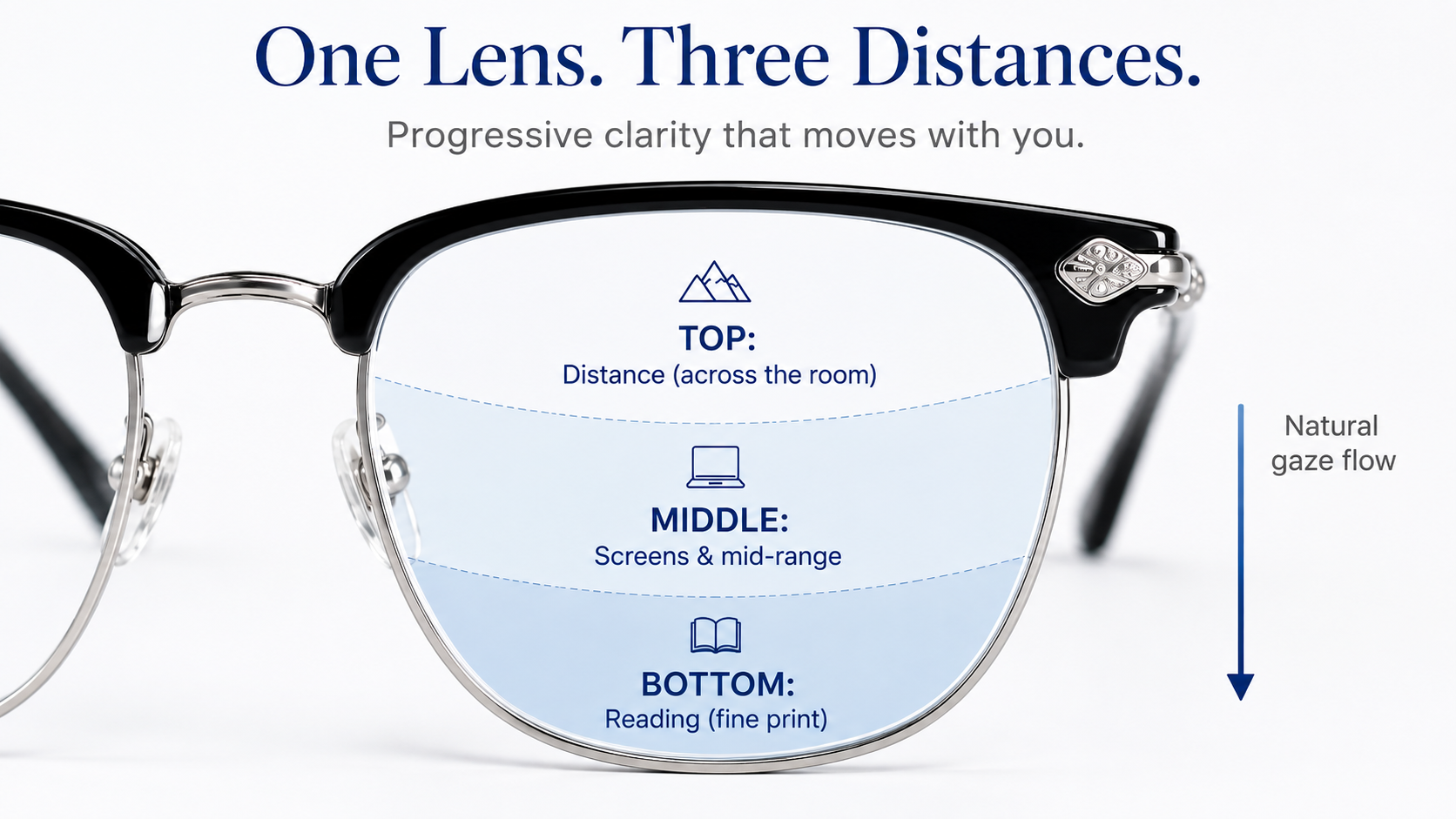
OptiReaders Pro are ready-made progressive multifocal reading glasses. The important word is progressive. A standard drugstore reader has one magnification across the whole lens: it makes the book sharp and everything past arm’s length soft, which is why you end up pushing them up your forehead every few minutes. A progressive lens changes power gradually from top to bottom, so the same pair handles three distances.
The upper band sits close to neutral for looking across the room. The middle band adds a moderate boost that lands where a laptop screen or a car dashboard sits. The lower band carries the full reading magnification for print, phones and medicine labels. Because the change is gradual there is no visible line and no jump between zones - the lens looks like ordinary glasses to everyone else.
They are not prescription eyewear and they are not sold as medical devices. They are built for one very common problem: the age-related loss of near focus called presbyopia, which is why small print starts blurring in your forties even if your distance vision is fine.
Full specifications
| Item | Detail |
|---|---|
| Lens type | Progressive multifocal, three blended zones, no visible line |
| Powers available | +1.00 to +3.50 in 0.25 steps |
| Coatings | Blue-light filtering, anti-glare, scratch resistant, anti-smudge |
| Frame material | TR90 memory polymer with slim metal detailing |
| Weight | Approximately 22 grams |
| Fit | Unisex, medium - suits most adult faces |
| In the box | Glasses, hardshell case, microfiber cloth |
| Prescription required | No |
| Returns | 30 days from delivery, product price refunded |
The full teardown of the lens, coatings and frame - including what each coating does in practice - is on the product deep dive page, and the lens optics are explained step by step in how the lenses work.
What they cost
There is one price list and it is the same for everyone. One pair is $29.99 plus $10.99 tracked shipping, which is $40.98 delivered. Two pairs are $49.99 with shipping free, so the second pair effectively costs $9.01 more than buying one. Three pairs are $69.99, also shipped free.
| Bundle | Price | Per pair | Shipping | Total |
|---|---|---|---|---|
| 1 Pair | $29.99 | $29.99 | $10.99 | $40.98 |
| 2 Pairs - Most popular | $49.99 | $25.00 | Free | $49.99 |
| 3 Pairs - Best value | $69.99 | $23.33 | Free | $69.99 |
It is a one-time payment. There is no subscription, no membership and no auto-ship. The reason most people take two pairs is not the discount - it is that readers get left in the other room. A pair by the chair and a pair in the bag removes the daily hunt. The pricing page works through every combination including add-ons, and the free shipping rules page covers the 2-pair threshold in detail.
Choosing your strength
If you already wear drugstore readers, order the same number you have now - the reading zone of a progressive lens is calibrated to match. If you have never bought readers, age is a reliable starting point because presbyopia progresses fairly predictably.
| Age | Usual starting power |
|---|---|
| 40 – 44 | +1.00 |
| 45 – 49 | +1.50 |
| 50 – 54 | +2.00 |
| 55 – 59 | +2.50 |
| 60+ | +3.00 |
Two practical rules. First, when you are between two powers, take the lower one - too much magnification narrows the comfortable reading distance and makes the lens feel twitchy. Second, if you spend most of your day at a monitor rather than with a book, stay a quarter-step lower again; the screen sits further away than print does. The strength guide goes deeper, and computer work covers desk setups specifically.
The first week
Progressive lenses require a small habit change, and being straight about that is more useful than pretending otherwise. For the first day or two your eyes will try to find the sharp zone by moving sideways. The trick is to move your head instead: point your nose at whatever you want to read, and the correct band lands in front of your pupils.
Expect some softness at the very outer edges of the lens - that is inherent to every progressive lens ever made, including prescription ones costing ten times as much. Expect stairs to feel slightly odd on day one; look at the step with your chin a little higher than usual. Most people stop noticing any of this within three or four days. The day-by-day plan is on the adjustment guide, and side effects and fixes lists what to do if something still feels wrong after a week.
Who they suit - and who should not buy them
They suit you if your close-up vision has drifted with age, your distance vision is broadly fine, you switch between print and screens through the day, and you are tired of owning three pairs of single-power readers.
They are the wrong purchase if:
- You have astigmatism. Readers cannot correct it, and the blur you are fighting will still be there.
- Your two eyes need noticeably different powers. Ready-made readers are the same strength in both lenses.
- You have glaucoma, cataracts, macular degeneration or any diagnosed eye condition - see your optometrist, not a website.
- You need distance correction for driving. The upper band is near-neutral, so it does not replace prescription distance lenses. See can you drive in them? for the full answer.
- Your close-up blur appeared suddenly. That warrants an eye exam first.
We would rather lose the sale than have you keep a pair that cannot solve your problem - which is also why the 30-day return exists and why we say plainly where readers stop and prescription lenses start.
How they compare
| Option | Distances covered | Typical cost | Trade-off |
|---|---|---|---|
| Drugstore single-power readers | Close-up only | $15-25 a pair | On and off all day; several pairs needed |
| Bifocals | Two, with a visible line | $150+ | Image jump at the line; ages the look |
| Prescription progressives | Three, custom-made | $300-800 | Exam, lab time and cost; needed for astigmatism |
| OptiReaders Pro | Three, ready-made | $29.99-$69.99 | Standard powers only; not a prescription substitute |
The head-to-heads are broken out one by one: versus drugstore readers, versus bifocals, versus prescription progressives and versus cheap online multifocals.
Buying safely: one store, no resellers
OptiReaders Pro are sold only at optireaderspro.net. We do not list on Amazon, eBay, Walmart, Temu, AliExpress, Etsy or Shein, and we do not authorise resellers. Listings using our photographs do appear on those marketplaces - they are copies with different lenses, and neither our guarantee nor our support covers them.
The checks are simple: the URL is optireaderspro.net, support replies from support@optireaderspro.net, prices are $29.99 / $49.99 / $69.99, and checkout is card payment on an encrypted page. Anything promising a secret coupon or a wildly lower price is not us. More on verifying the official website and spotting copycats.
Shipping, returns and support
Orders are packed within 24 hours on business days and ship tracked. Typical transit is 5-9 business days to the United States, Canada, the United Kingdom, Ireland, Australia and New Zealand, and 7-14 business days elsewhere; you get a tracking link by email when the parcel is scanned. Full detail by destination is on the shipping page, and order tracking explains how to follow a parcel already on its way.
Returns run for 30 days from delivery. Email support@optireaderspro.net with your order number and we arrange it - no restocking fee and no explanation required. The process is written out on returns and refunds.
The verdict
If your arms have started getting shorter and you are cycling between reading glasses, computer glasses and squinting, one progressive pair at $29.99 solves the daily version of that problem for a fraction of what a prescription progressive costs. If your eyes need genuine correction rather than magnification, spend the money on an exam and a prescription pair - that is the honest split, and it has not changed.